

Sunday, 5 November 2017

Friday, 3 November 2017

Sunday, 29 October 2017
Collaboration: Character Design - The Granny
 |
| Makeup/Accessories/Details |
 |
| Glasses No. 1 |
 |
| Hairstyles |
 |
| Accessories |
 |
| Glasses No. 2 |
 |
| Combined Elements |
Friday, 27 October 2017

Wednesday, 25 October 2017
Perspectives: 5 Reasons Why Funny Games is Postmodern

1: The film challenges the ideological genre of horror films. The director Michael Haneke draws the audience in but deviates the expectation of the horror genre. In the horror genre the viewer is expected to see the most brutal scenes, Haneke has deconstructed and flipped this making the most macabre parts of the film unimportant to its understanding showing it as an anti-horror horror film. A loud gunshot is heard but shown while one of the Antagonists Paul is seen casually making a sandwich.
2: Haneke appropriated his own film as the original was German, Haneke remade it shot for shot for the American audience with American actors.
3: Heneke also breaks the boundaries of horror genre with the set design and costumes, usually we are familiar with the antagonists wearing dark colours and the set reflecting the scenes which unfold in horror with dark hues prevalent, however Paul and Peter the main protagonists are seen wearing white which represents purity and innocence while the house is also of light colours.
4: Parts of the film are non linear and fragmented as Paul and Peter make a bet with the family that they will be dead or alive before sunset, Paul turns to the camera and asks the viewer "who are you betting on". Paul and Peter are also seen towards the end of film dictating the pastiched way in which the horror genre is structured saying"struggle is boring" and "we want a real ending with a plausible plot". The most unfathomable scene in the film is after the mother Ann shoots Peter and then Paul picks up the remote to the TV and rewinds the whole scene to revert back to before her grabbing the gun to which he then now knows to reach for it before she gets the change to kill his sidekick Peter.
5: Funny Games is a simulacra of film. The ending sees Paul and Peter saying "But isn’t fiction real" “Why?” “Well you can see it in the movie, right?” fiction is described as not being real but if our viewing of something is the only connection to the outside world, and if both “fiction” and “reality” can be seen, how can someone distinguish between them?. speaking of the self referral parts of Funny Games where Paul speaks to the camera Haneke describes "It allowed me to understand illusion intellectually.”
Perspectives Lecture 6: Key words

Normativity
Concerns what we should or ought to do and our evaluations of things or states of affairs
Binary opposition
A binary opposition is a pair of related terms or concepts that are opposite in meaning.
examples include-
White/Black
Straight/Gay
Rich/Poor
Healthy/Unhealthy
Fat/Thing
The tendency to dissolve binary categories and expose their arbitrary cultural co-dependency is associated with postmodernism.
Deconstruction
To “deconstruct” is not the same as to destroy. Deconstruction attempts to undo logical contradictions, to overturn rigid conceptual oppositions while releasing new concepts and meanings that could not be included in the old system.
Différance
Différance is an attempt to conjoin the differing and deferring aspects involved in arche-writing (an original form of language which is not derived from speech) in a term that itself plays upon the distinction between the audible and the written.
Derrida finds the opposition between “speech” and “writing.” This binary logic functions in an illicit way to establish speech as the means of giving “presence” to the world, while writing is deemed derivative and inferior.
Reinscribe
Establish or rename in a new and especially stronger form or context.
Cognitive dissonance
Having inconsistent thoughts, beliefs, or attitudes, especially relating to behavioural decisions and attitude change.


Monday, 23 October 2017


Sunday, 22 October 2017
Three Act Structure in Avatar: Review
 |
| Avatar Poster |
Avatar directed by James Cameron follows the three act structure in telling the story of how the protagonist Jake Sully goes on the Hero's Journey. Jake leaves the mundane human world and travels to Pandora showing the obstacles he faces along with the final resolution.
"The 3-act structure is an old principle widely adhered to in storytelling today. It can be found in plays, poetry, novels, comic books, short stories, video games, and the movies. It was present in the novels of Conan Doyle, the plays of Shakespeare, the fables of Aesop, the poetry of Aristotle, and the films of Hitchcock. It’s older than Greek dramaturgy. Hollywood and Broadway use it well. It’s irrefutable and bullet-proof" (Moura, G 2014)
Jake is introduced to the story as a veteran who is a paraplegic. His twin brothers Avatar was created which is a duplicate of the Blue skinned Alien like hunters gatherers called the Na'vi that roam Pandora. Jake travels to Pandora and soon starts to feel one with the Na'vi as he is seen as one of their own and is treated as such, gaining their loyalty and learning the lay of the lay of the land
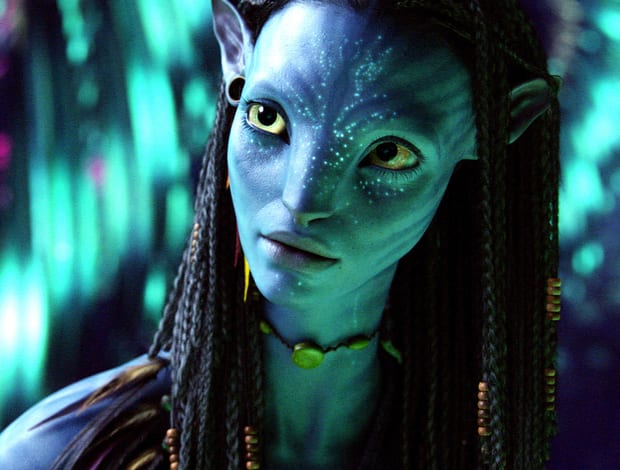 |
| The Na'vi |
The second act showing the obstacles that Jake faces are when he starts to feel more comfortable in the Pandora universe rather than earth as he is loyal to the Na'vi the military that he is supposed to be working for are out to destroy the Pandora universe and all the creatures, plants and life that resides in the technicolour world. The whole objective of the military is to take a precious source of energy that is abundant in pandora.
War is the conflict that Jake now faces as the antagonist Colonel Miles Quaritch is violent and aggressive and sends flying however crafts equipped with missiles to bomb the dreamlike world as he cannot fathom getting the source of energy without killing everything in his path.
"Now we’ve been thrust into Act II (film-speak for Parts 2 and 3 of the equivalent novelistic storytelling model, comprising the middle 50% of the total length), where the story is no longer in set-up mode, it’s in response mode. The context of everything Jake does until the Mid-Point will be his reaction to his new quest in the face of the obstacles placed before him." (Storyfix.com, 2017)
The third act sees the resolution and climax to the obstacles that Jake has had to face. Many of Jakes friends who were in the military decided to fight along side him as they repelled the barbaric brutality that Quaritch has put in place against Pandora and many of them have paid with their lives. The ending sees Jake almost dying but manages to win the battle against the military and Quaritch who is killed. Jake's human body is laid at the tree of souls where his life form is permanently transformed into his Avatar so that he can truly be one with the Na'vi and Pandora.
 |
| Final Scene |
Bibliography
Storyfix.com. (2017). Deconstructing Avatar: Act II (The First Half Up to the Mid-Point) - Storyfix.com. [online]
Available at: http://storyfix.com/deconstructing-avatar-act-ii-the-first-half-up-to-the-mid-point [Accessed 22 Oct. 2017].
Moura, G. (2014). The Three-Act Structure. [online] Elementsofcinema.com.
Available at: http://www.elementsofcinema.com/screenwriting/three-act-structure/
[Accessed 16 Oct. 2017].
Illustration List
[image] "Avatar Poster" Available at: https://www.europosters.eu/posters/avatar-limited-ed-one-sheet-sun-v13494.
[Accessed 22 Oct. 2017].
Anon, (2017). "Final Scene" [image] Available at: http://james-camerons-avatar.wikia.com/wiki/File:Jake_stays_on_Pandora_forever.jpg
[Accessed 22 Oct. 2017].
Anon, (2017)."The Na'vi" [image] Available at: https://moviepilot.com/posts/3755046
[Accessed 22 Oct. 2017].
Saturday, 21 October 2017


Subscribe to:
Posts (Atom)